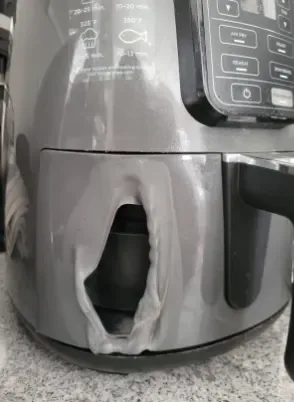

If you’ve ever typed “are air fryer liners safe” into a search bar, you’ve probably seen a messy mix of fear-mongering and casual shrugs. The truth sits somewhere in between. Yes, air fryer liners are safe when used correctly, but they carry real fire and chemical risks if you ignore their limits.
The concern isn’t hypothetical. Per FDA food contact substance guidelines, food-grade silicone remains stable up to roughly 260°C (500°F), while most parchment paper degrades and begins charring around 220°C (428°F). Understanding those thresholds, plus how your air fryer’s fan interacts with a lightweight liner, is what separates a convenient cleanup hack from a smoke-filled kitchen.
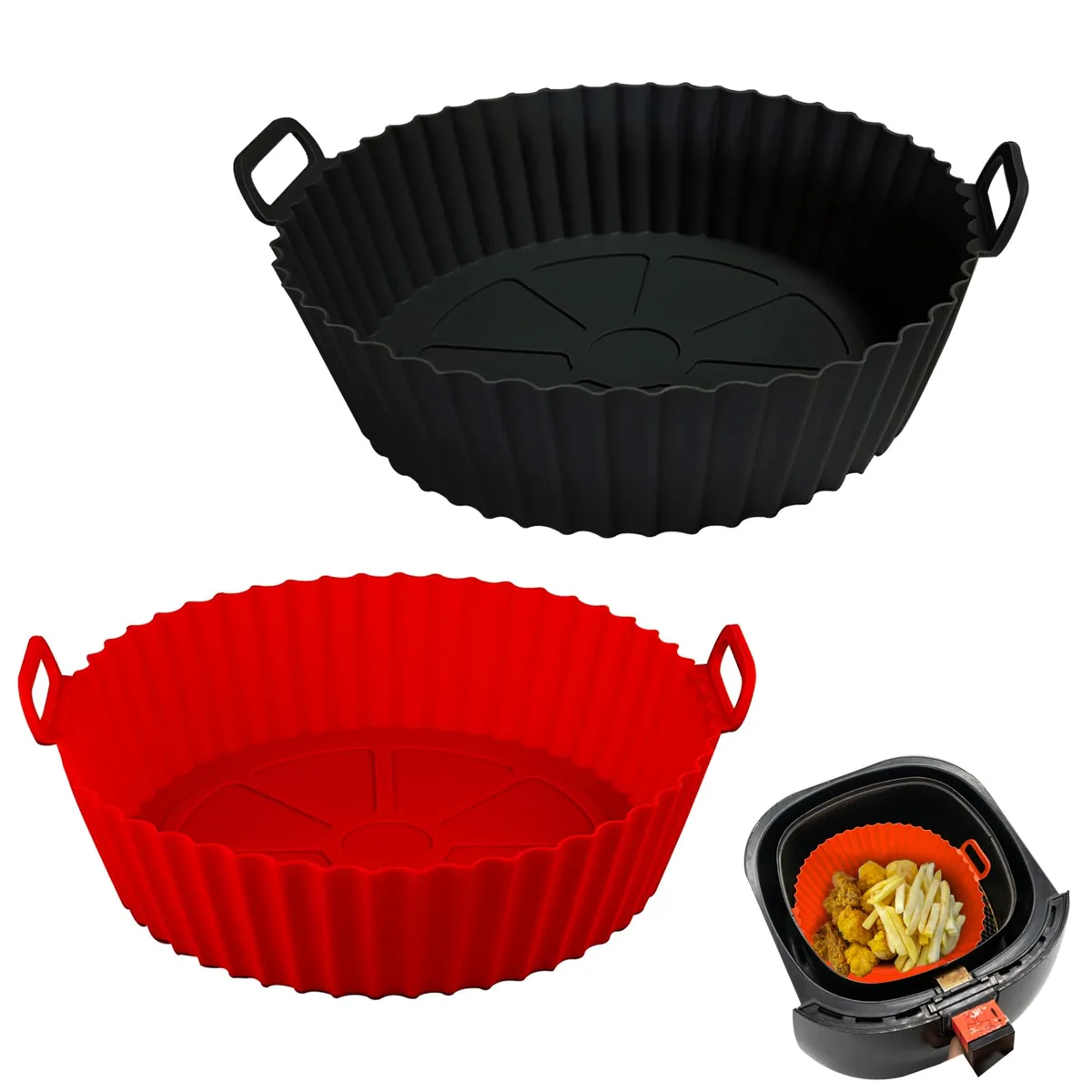
Image source: Web (Bing) / amazon.com (Web image (fair-use with source credit))
Quick Answer: Are Air Fryer Liners Safe
Yes, air fryer liners are safe when used correctly. Choose food-grade silicone or heavy-duty parchment rated for high heat. Always anchor the liner with food on top.
Never preheat with a liner inside the basket. Stay below the material’s rated temperature limit. Replace worn or brittle liners immediately.
Why This Question Deserves More Than a Yes or No
Air fryer liners exploded in popularity for one simple reason: cleanup. The mesh baskets in most models trap grease in every crevice, and scrubbing them after every meal gets old fast. Liners promise a lift-out-and-toss solution, and for the most part, they deliver.
But here’s what the marketing doesn’t tell you. When you place a thin sheet of paper or silicone inside a chamber with a high-velocity fan and a red-hot heating coil, you’ve introduced a new variable. That variable behaves differently depending on temperature, liner size, and even what you’re cooking.
The stakes are genuine. Consumer Product Safety Commission records include incidents where displaced liners contacted heating elements, producing smoke and flame. The National Fire Protection Association also flags unattended cooking as a leading cause of kitchen fires, and a flying liner under preheat definitely qualifies as unattended.
So no, a simple “yes” or “no” doesn’t cut it. You need to know which materials hold up, which sizes fit safely, and what mistakes turn a convenience item into a hazard. That’s what this guide covers, with manufacturer specs and independent standards as the baseline.
How Air Fryer Liners Actually Work
An air fryer is essentially a countertop convection oven. A heating element sits near the top, and a powerful fan circulates hot air around your food at high speed. That circulation is what crisps food, but it’s also what makes a lightweight liner dangerous.
When you place a liner in the basket, it sits between your food and the metal mesh. The fan pulls air from the sides, pushes it over the heating element, and forces it downward onto the food. If the liner is flat and unweighted, that downward airflow can catch its edges and lift it.
The result is a liner that flutters, folds, or even launches upward. If it touches the heating element directly, paper will ignite, and silicone may melt or release chemicals. Neither outcome is acceptable.
This is why liner shape matters. Bowl-shaped parchment edges create a barrier against the basket walls, reducing lift. Flat sheets offer nothing to grip.
And the size must match your basket precisely; a liner that’s too small leaves gaps where air can get underneath.
The mechanism is simple physics. Heated air expands, rises, and moves fast. Give it a loose edge to catch, and it will.
Keep your liner snug and weighted, and it stays put.
Material Safety: Paper vs. Silicone vs. What’s in Between
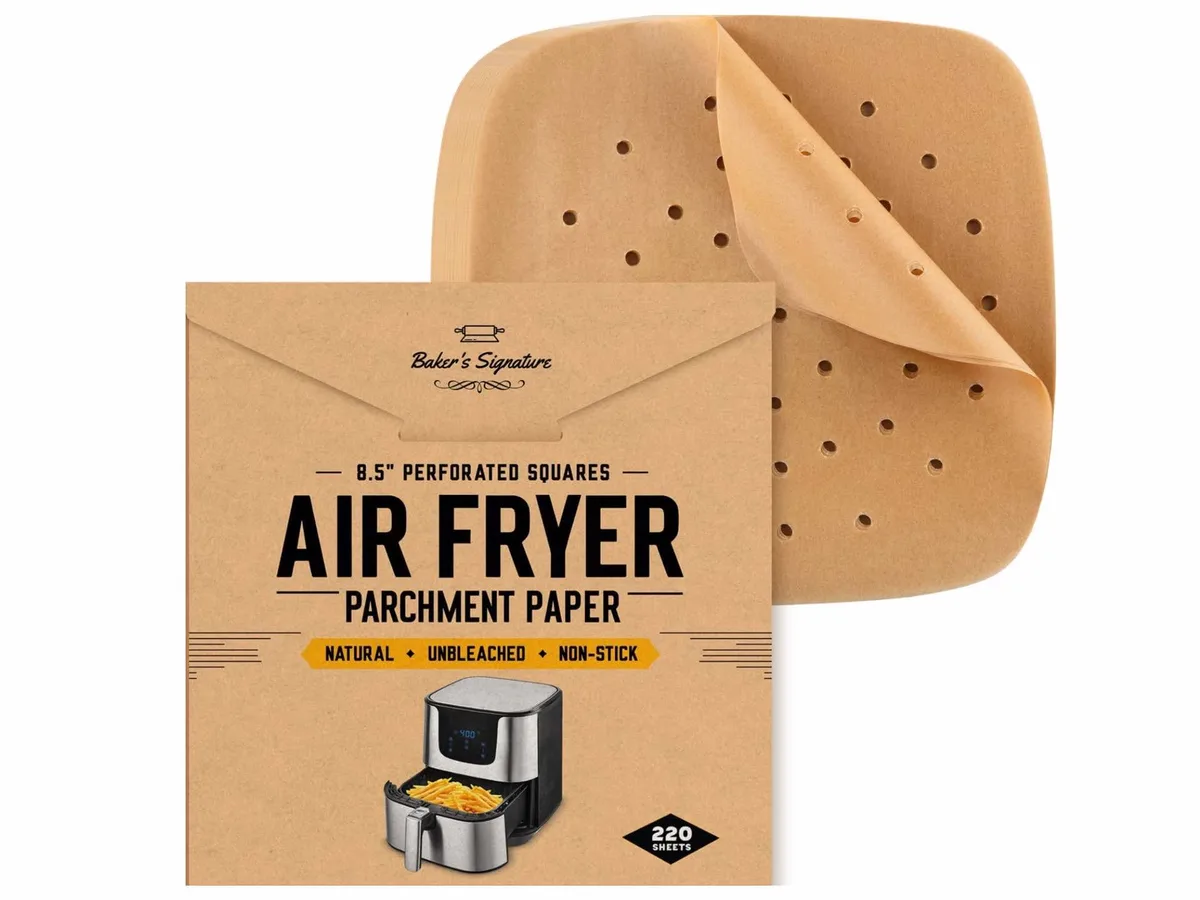
Image source: Web (Bing) / toolsandtoys.net (Web image (fair-use with source credit))
The two dominant liner types are disposable parchment paper and reusable silicone mats. They’re not interchangeable in terms of safety or performance. Each has distinct thermal limits and chemical profiles.
Parchment paper is cellulose fiber coated with silicone for release properties. The coating is what makes it non-stick and somewhat heat-resistant. But the paper base degrades.
Per manufacturer specifications, most parchment liners carry a max temperature rating between 220°C and 230°C (428°F to 446°F). Push past that, and the paper browns, embrittles, and can catch fire.
Unbleached parchment avoids chlorine processing, which matters if you’re exposed to high heat repeatedly. Bleached varieties may contain trace dioxins, though FDA considers levels safe for food contact. For daily high-heat use, unbleached is the cleaner choice.
Silicone mats are rubber-like sheets made from silica and carbon. Food-grade silicone is inherently stable and non-reactive. High-quality mats are rated up to 260°C (500°F), which covers nearly every air fryer’s maximum setting.
The risk here is cheaper silicone containing fillers or volatiles that off-gas at heat.
| Material | Max Safe Temp | Reusable | Fire Risk | Chemical Concern |
|---|---|---|---|---|
| Parchment paper | 220–230°C (428–446°F) | No | High if unweighted | Bleach residues in bleached types |
| Silicone mat | Up to 260°C (500°F) | Yes | Low | Fillers in low-grade brands |
| Aluminum foil | Varies, can withstand high heat | No | High if touching element | Aluminum migration into acidic foods |
Aluminum foil is a third option, but it’s the least safe. It conducts heat directly, has sharp edges that can scratch your basket’s nonstick coating, and reacts with acidic foods like tomatoes or citrus. If you use it, keep it below the food and away from the element.
What about “reusable parchment”? It’s usually coated fabric, not true parchment. Its safety depends entirely on the coating’s heat rating.
Check the label for a specific temperature range, and if it’s missing, assume it’s not safe above 200°C (392°F).
The #1 Fire Hazard: Fly-Away Liners and the Heating Coil
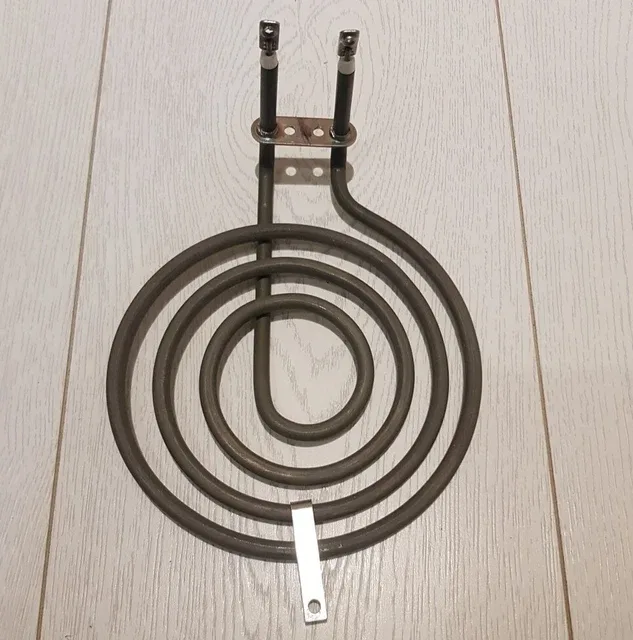
Image source: Web (Bing) / picclick.co.uk (Web image (fair-use with source credit))
The single most common cause of air fryer liner fires is the fly-away effect. It happens when the fan lifts an unweighted liner, pulls it toward the heating element, and the liner ignites. Paper is the usual culprit, but thin silicone can warp and fold under extreme airflow, too.
The conditions that trigger it are predictable. An empty basket with a liner during preheat is the highest-risk scenario. Without food to hold it down, the liner is at the mercy of the fan.
Even during cooking, a liner that’s too small or too large can shift and expose an edge.
Prevention requires three habits. First, never preheat with a liner inside. Add it only after the air fryer reaches temperature.
Second, ensure your liner fits flush against the basket walls, with no gap that allows air underneath. Third, always place food directly on the liner, distributing weight across its surface.
If you’re cooking something small like a single burger patty or a few fries, the center may be weighted while the edges flutter. In that case, use a bowl-shaped parchment liner with a high lip, or switch to a silicone mat that’s rigid enough to resist lift.
When a liner does fly up and touch the element, you’ll see smoke within seconds. Paper ignites quickly. Silicone may melt and drip.
If this happens, turn off the air fryer immediately, unplug it, and let everything cool. Do not open the basket while the unit is hot; oxygen will feed the flames.
Temperature Limits: The Numbers That Keep You Safe
Image source: Web (Bing) / globalsources.com (Web image (fair-use with source credit))
Every liner on the market has a thermal ceiling, and crossing it is where safety falls apart. The numbers aren’t arbitrary; they derive from the material’s glass transition temperature and decomposition point.
Parchment paper, as of 2026, typically lists a maximum safe temperature between 220°C and 235°C (428°F to 455°F) on its packaging. Many air fryers reach 230°C (446°F) on their highest setting. That’s cutting it close.
If your recipe calls for maximum heat, switch to silicone.
Silicone mats, from reputable manufacturers, withstood tests up to 260°C (500°F) without melting or releasing detectable volatiles. This margin covers all standard air fryer temperatures plus a buffer for temperature overshoot. The caveat is brand quality.
Cheap silicone may contain plasticizers that lower its actual threshold.
Temperature also affects chemical stability. At high heat, low-grade silicone can hydrolyze or depolymerize, releasing cyclic siloxanes. Research shows good food-grade silicone keeps migration levels well within EU and FDA limits.
Unknown off-brands don’t earn that trust.
What about the temperature reading on your air fryer? The display shows the target air temperature, not the actual temperature at the liner surface. Surfaces near the heating element can run hotter than the set point.
If you’re at the maximum setting, your liner may be exposed to temperatures above its rating even if the display stays steady.
The practical rule is simple. Use parchment for low-to-medium heat recipes up to about 200°C (392°F). Use silicone for anything higher, especially air frying, roasting, or reheating at maximum settings.
And check your liner’s printed specifications; if no temperature is listed, find one that has it.
The Safe-Use Sequence: From Preheat to Plating
The difference between a safe liner session and a smoke-filled kitchen often comes down to order of operations. Follow this sequence every time, and you eliminate the vast majority of risk.
Step 1: Preheat with an empty basket. Never place a liner inside during preheating. The fan runs at full speed, and there’s no food to anchor anything down. An empty basket with a liner is the single most dangerous configuration.
Step 2: Insert the liner after preheat. Once the air fryer hits its target temperature, open the basket and place your liner. Make sure it sits flush against the walls, with no gaps that let air flow underneath. Bowl-shaped liners with a lip are safest for models with tall baskets.
Step 3: Add food immediately. The food’s weight is what holds the liner in place. Distribute it evenly across the surface. For small batches, concentrate the food in the center and press the liner’s edges against the basket walls to keep them from fluttering.
Step 4: Monitor during cooking. Check on your food at least once mid-cycle. If you notice the liner lifting, curling, or shifting, remove the food, reposition the liner, and reload. It’s a 30-second fix that prevents a much larger problem.
Step 5: Remove the liner safely. After cooking, use tongs to lift the liner out while it’s still warm but not scorching. Hot grease-soaked paper can drip. Let it cool on a heat-safe surface before discarding.
Silicone mats can be rinsed immediately and air-dried.
Seven Mistakes That Turn a Convenience Into a Hazard
Even experienced cooks make these errors. Aggregate reviews and safety reports show these seven are the most common:
1. Preheating with the liner inside. We’ve said it before, but it’s the leading cause of liner ignition. The unprotected liner gets sucked directly onto the heating element within seconds.
2. Using a liner that’s too small. A liner that doesn’t reach the basket walls leaves an open channel for air. The fan pulls the liner up through that gap, and it folds or flips under the food.
Always match the liner to your basket’s exact dimensions.
3. Cooking without enough food to anchor it. A single burger patty or a handful of fries won’t weigh down a large parchment liner. The empty edges flutter freely.
Use a smaller liner or add more food.
4. Reusing parchment paper. Paper degrades with each heat cycle. What was rated for 230°C (446°F) on the first use might char at 190°C (374°F) on the third.
Toss parchment after a single use. Silicone mats can be reused, but inspect them for cracks or discoloration first.
5. Ignoring temperature ratings. Cheap liners often list vague or missing temperature specs. If the package doesn’t state a maximum heat rating, it’s not safe for air frying.
That’s a hard rule.
6. Cutting silicone to fit. Slicing a silicone mat compromises its structural integrity and exposes unsealed edges. Those edges can shred, melt, or flake into your food.
If it doesn’t fit, buy the correct size.
7. Letting food touch the basket walls. When food sticks out past the liner and contacts the basket’s metal mesh, drippings land directly on the heated surface. That causes smoke and can trigger flare-ups.
Keep all food within the liner’s footprint.
Paper Liners vs. Silicone Mats vs. No Liner: A Safety Comparison
| Factor | Parchment Paper | Silicone Mats | No Liner |
|---|---|---|---|
| Fire risk if unweighted | High | Low | None |
| Max safe temperature | 220–235°C (428–455°F) | Up to 260°C (500°F) | N/A |
| Cleanup effort | None, toss after use | Rinse and air-dry | Scrub required |
| Cost per use | $0.05–$0.20 | Reusable for 1–2 years | $0 |
| Chemical exposure risk | Low, unless burned | Low, if food-grade | Depends on basket coating |
| Crispiness impact | Slightly reduces airflow | Perforated versions improve airflow | Best airflow, crispiest results |
| Risk to basket coating | Protects it fully | Protects it fully | Abrasion and scratching over time |
Parchment wins on convenience. Silicone wins on long-term value and safety margin. No liner wins on crispiness and simplicity.
Your choice depends on what you prioritize. If you cook at high heat daily, silicone is the safest call. If you want zero cleanup and don’t mind buying replacements, parchment works for moderate temperatures.
If you’re chasing maximum browning on wings or fries, skip the liner entirely and accept the scrubbing.
What “Food-Grade” Actually Means — and What Certifications to Look for
The phrase “food-grade” gets thrown around a lot, but it’s not a single universal standard. It refers to materials approved for contact with food under specific conditions, including temperature.
For silicone, the key certification is an FDA Food Contact Substance notification. This confirms the material won’t migrate harmful chemicals into food under intended use. The FDA has cleared certain silicone formulations for repeated use up to 260°C (500°F).
Ask the manufacturer for evidence of this compliance.
For parchment paper, check whether it’s bleached or unbleached. Unbleached parchment avoids chlorine and is the safer choice for high-heat cooking. Some brands also carry NSF certification, which verifies the material meets food-contact safety criteria for commercial-grade equipment.
Then there’s BPA-free labeling. BPA is a plastic additive, not a silicone or paper component. Seeing “BPA-free” on a liner is meaningless marketing.
What matters is the actual material composition and its temperature rating.
What should you do? Check the product page for explicit temperature specifications and contact naming. For silicone, look for “100% food-grade silicone” with a stated max temperature and a brand that publishes its compliance.
For parchment, seek unbleached options with a listed heat rating. If a product is vague about its materials, move on. That vagueness is the biggest red flag.
When to Ditch the Liner Entirely
Sometimes the safest liner is no liner at all. Air fryers cook perfectly well without one, and the basket’s nonstick coating handles most foods without sticking when you use a light spritz of oil.
You should skip liners in three situations. First, when cooking at maximum heat above 240°C (464°F). No paper liner belongs at that temperature.
Silicone might survive, but you’re trading away airflow for cleanliness.
Second, when you want maximum crispiness. A liner sits between the basket mesh and your food, slightly reducing down-draft airflow. Perforated silicone helps, but nothing crisps like direct contact with the basket’s heat-conducting surface.
Third, when cooking acidic foods like tomatoes or marinated citrus-heavy dishes. Acidity can react with the liner’s coating over a long cook, especially in silicone. Skip the liner and use the basket directly.
In short, weigh your priorities. Cleanup convenience matters, but it’s not the only factor. A clean basket you scrub for two extra minutes is still a better outcome than a melted liner or a smoke alarm at 7 PM.
If you cook mostly moderate-temperature foods and value ease, liners are fine. If you’re chasing texture and high heat, go bare.
Frequently Asked Safety Questions
Can burning parchment paper release toxic fumes?
Yes. Burning paper releases carbon monoxide, fine particulate matter, and trace chemicals from the coating. If a liner catches fire, turn off the air fryer, unplug it, and ventilate the area immediately.
Don’t open the basket while it’s still hot. Let it cool completely before inspecting the damage.
Is it safe to preheat with a liner inside?
No. Preheating with a liner in an empty basket is the single most dangerous configuration. The fan runs at full speed with nothing anchoring the liner, which allows it to get sucked directly onto the heating element.
Always insert the liner after the preheat cycle finishes and add food immediately.
How long can I reuse a silicone liner?
Quality food-grade silicone mats last one to two years with regular use. Wash them with warm soapy water, dry them fully, and inspect for cracks, warping, or discoloration before each use. Replace at the first sign of damage.
Compromised silicone can shed particles into your food.
What if my liner doesn’t fit my basket perfectly?
Don’t use it. A liner that’s too small leaves gaps where air flows underneath, causing it to lift and flutter toward the heating element. A liner that’s too large folds over the basket rim and blocks airflow.
Measure your basket’s internal diameter and buy exact-fit liners only.
The Final Safety Verdict
Yes, air fryer liners are safe when you follow the rules we’ve covered. Choose food-grade silicone for high-heat cooking. Use parchment only below 220°C (428°F) with food weighing it down.
Never preheat with a liner inside. Always match the liner size to your basket exactly.
If you’re after convenience, parchment is fine for moderate-temperature meals. If you cook hot and often, silicone is the safer long-term investment. And if you’re chasing maximum crispiness, skip the liner and scrub the basket.
Cleanup is a fair trade for safety and texture.
That’s the whole equation. Respect material limits, keep liners weighted, and you’ll never have to wonder if your next batch is your last in one piece.