You’re standing in your kitchen, air fryer in hand, looking up at the cabinets and wondering if you can slide it underneath without wrecking your woodwork. It’s a fair question. The short version: yes, but only under the right conditions.
That’s exactly what we’re going to break down here. We’ve combed through manufacturer manuals, UL testing standards, and real-world owner reports to give you a clear answer on can air fryers go under cupboards. As of 2026, most major brands recommend at least 4 to 6 inches of clearance above the unit.
But the real answer depends on your specific air fryer model, your cabinet material, and where the vents sit. Let’s walk through it.
Quick Answer: Can Air Fryers Go Under Cupboards
Yes, air fryers can go under cupboards if you have enough clearance. You need at least 4 to 6 inches of space above the unit. Your cabinet material must tolerate heat.
The vent must not be blocked. Check your specific model’s manual for exact requirements. If you’re short on space, the answer changes.
Why This Question Matters (and What Goes Wrong)
Most people assume an air fryer is just a small countertop appliance that sits anywhere. That assumption is what leads to damage. Upper cabinets hang roughly 18 inches above standard countertops.
An average air fryer stands between 10 and 14 inches tall. That leaves just 4 to 8 inches of space. Tight, but workable.
The problem is that heat doesn’t just rise. It radiates, reflects, and traps.

Image source: Bing (Web (fair-use with source credit))
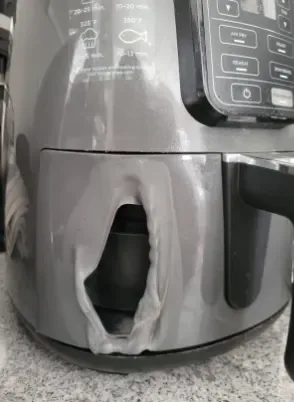
The underside of your cabinet absorbs that heat every time you cook. Wood starts discoloring around 140°F. Laminate can blister at similar temperatures.
And since air fryers run at 200°F to 400°F internally, the exterior heat output is substantial. Manufacturer specifications indicate that surface temps near the exhaust can reach 150°F or higher. That’s enough to warp a cabinet door over time.
Aggregate reviews across multiple appliance forums report the same pattern: users who placed air fryers too close to cabinets saw visible damage within months. What starts as a slight yellowing becomes permanent discoloration. In worse cases, the heat causes the finish to bubble and peel.
Your cabinet isn’t going to catch fire in normal use, but you might end up repainting or replacing it.
The real issue is that clearance advice online is often generic. “Just leave 5 inches” gets repeated everywhere. But a rear-venting model behaves completely differently from a top-venting one.
Our goal here is to help you figure out what actually applies to your setup.
The Short Answer: Yes, But Only If (Quick Decision Guide)
Here’s the deal in plain terms. You can place your air fryer under a cupboard if three conditions are met.
- Your air fryer’s vent is not pointing directly at the cabinet above.
- You have at least 4 to 6 inches of clearance between the top of the unit and the cabinet bottom.
- Your cabinet is made of heat-resistant material or has a protective barrier.
If any of those conditions fails, you’re gambling. Not necessarily with fire, but with your kitchen’s appearance and your appliance’s lifespan.
When does the answer become a flat no? If your air fryer vents from the top and you have less than 4 inches of space, don’t do it. If your cabinets are made of particleboard with a thin laminate finish, that material degrades faster than solid wood.
If your air fryer has a rear vent and sits flush against a backsplash with a cabinet directly above, the heat has nowhere to go.
Here’s a quick decision framework:
| Condition | Verdict |
|---|---|
| Top vent + less than 4 inches clearance | No |
| Top vent + 4 to 6 inches clearance | Yes, with monitoring |
| Rear vent + 4 to 6 inches clearance + open air flow | Yes |
| Rear vent + blocked airflow behind unit | No |
| Any vent + wooden shelf directly above | No |
Use that as your starting point. The next section explains why vent placement matters so much.
How Heat and Venting Actually Work (and Why Vents Change the Rule)
An air fryer is essentially a small convection oven with a fan. It circulates superheated air around your food to crisp it up. That fan pushes hot air out through vents.
Where those vents sit determines how the heat behaves in your kitchen.
The Physics of Hot Air Rising (and Why It Doesn’t Just Go Straight Up)
Hot air does rise. But it doesn’t rise in a neat straight column. It swirls, mixes with cooler air, and spreads outward as it ascends.
Think of steam rising from a pot. It doesn’t stay in one narrow stream. It fans out and dissipates.
The same thing happens inside your air fryer’s exhaust plume.
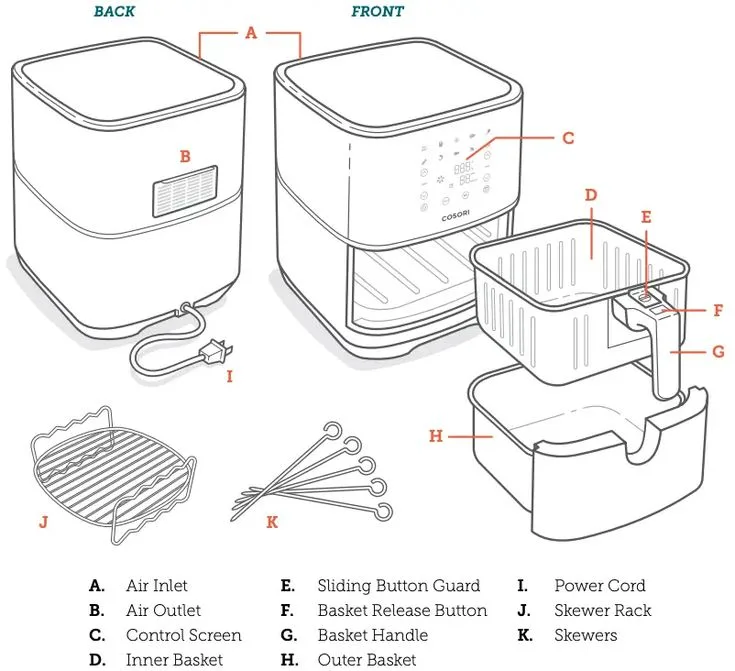
Image source: Web (Bing) / pinterest.com (Web image (fair-use with source credit))
If your air fryer vents from the top, that hot air blasts directly upward into whatever is above it. A cabinet just 5 inches overhead takes the full force of that heat. If your air fryer vents from the rear, the air shoots backward toward the wall.
That’s safer for the cabinet above, but it creates a different problem: the heat bounces off the backsplash and collects under the unit. That trapped heat can damage your countertop instead.
Some models vent from the sides or the bottom. Side venting is generally the safest for under-cabinet placement because the hot air escapes horizontally. Bottom venting is rare and usually only found in some compact models that exhaust through the base.
There’s also steam to consider. Air fryers release moisture from food as it cooks. That steam carries grease particles.
Over time, it coats the underside of your cabinets with a sticky film. That film attracts dust. It also accelerates finish degradation.
So even if the heat isn’t extreme enough to cause immediate damage, the long-term effect of steam and grease is a discolored cabinet surface.
You may also like: Are Air Fryer Liners Safe
The Three-Decision Branch: What Makes Your Setup Different
Your kitchen setup determines whether the answer is yes or no. Every home is different. Let’s break it down into three common scenarios.
Branch 1: The Standard Counter + Overhead Cabinet (18-Inch Gap)
This is the most common setup in American homes. Upper cabinets sit 18 inches above the countertop. A typical air fryer stands between 11 and 14 inches tall.
That gives you 4 to 7 inches of clearance. This scenario can work, but it depends on vent placement.
If your air fryer vents from the top and you’re at the smaller end of that range, you’re pushing it. The safe play is to pull the unit forward so the exhaust plume clears the cabinet edge. If your air fryer vents from the rear or side, you’re generally fine as long as the unit has breathing room on all sides.
Branch 2: The Tight Fit (Under 6 Inches of Clearance)
This is where most people run into trouble. Maybe you have a taller air fryer or your cabinets hang lower. Either way, anything under 6 inches needs extra caution.
Your options are limited. You can install a heat shield on the underside of the cabinet. That’s a sheet of metal or heat-resistant material that reflects heat away.
You can also place the air fryer on a pull-out tray so you can slide it forward during cooking. The simplest option is to move the air fryer to a different spot entirely.
Branch 3: The Blocked Vent Scenario (Built-Ins, Nooks, and Alcoves)
This is the silent killer. Some kitchens have built-in nooks or alcoves designed for microwaves or small appliances. These spaces are often tighter than open countertops.
If you slide an air fryer into a space with less than 2 inches of clearance on all sides, you’re suffocating it.
Here’s what happens. The fan can’t pull in enough fresh air. The internal temperature climbs higher than the thermostat expects.
The unit may run hotter, cook unevenly, or trigger its overheat protection and shut off. In extreme cases, the plastic housing can warp. This is where fire risk becomes real, not just cosmetic damage.
If your air fryer’s manual specifies rear clearance and your nook doesn’t provide it, don’t use the air fryer there. The manufacturer’s warning exists for a reason.
So which scenario are you in? Measure your space, locate your vents, and check your cabinet material. That brings us to the practical steps.
Final Verdict
Yes, you can put an air fryer under cupboards, but don’t force the fit. Check your model’s manual first. Keep the vents clear and give the fryer enough space above it. If hot air hits the cabinet, move the fryer to a more open spot.
In my view, a little extra space is worth it. A few inches of room can save your cabinet from heat, steam, and grease. When in doubt, pull the air fryer forward while it runs, or use it on a clear counter. Think of airflow as the air fryer’s breathing room.